Laringe Segmentation And Tracking
Laringe segmentation using traditional methods of object detection and tracking in a standard quality video.
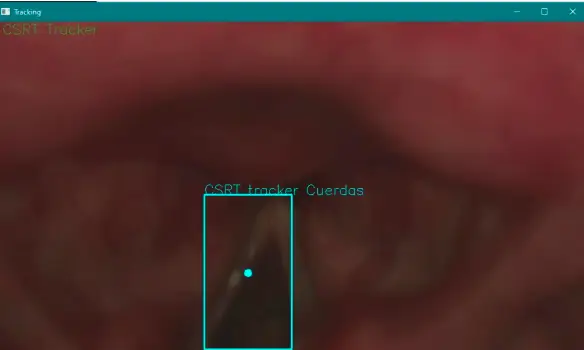
🧠 Project Overview
This project focuses on the segmentation and tracking of critical anatomical zones of the larynx, specifically the glottis and the vocal cords, from real laryngoscopic videos. It was developed as part of my Biomedical Engineering degree thesis.
Voice disorders can hide serious diseases such as laryngeal cancer or vocal papillomatosis. Early detection is crucial, yet current diagnostics often rely on manual frame-by-frame analysis. My goal was to automate this using computer vision and image processing techniques.
🎯 Objectives
- Develop an automated system for segmenting and tracking glottal and vocal fold regions in video.
- Provide clinicians with tools for improved diagnostics and treatment planning.
- Explore classic segmentation algorithms (thresholding, watershed, active contours) and tracking methods (Kalman filter, CSRT, MIL, etc.).
🧪 Technologies and Methodologies
- Programming Languages: Python, MATLAB
- Libraries: OpenCV, NumPy, SciPy, Matplotlib
- Segmentation techniques:
- Thresholding and histogram analysis
- Active contours (Snakes)
- Watershed transform
- K-means clustering
- Tracking algorithms:
- Optical Flow
- Kalman Filter
- CSRT, MIL, Boosting, and others
🔍 Results
- The developed segmentation methods achieved high accuracy in isolating glottis and vocal cords even under varying illumination and anatomical conditions.
- The tracking systems allowed continuous follow-up across video frames, paving the way for dynamic analysis of voice disorders.
- Evaluation was done using real clinical footage with different anatomical challenges.
💬 Key Takeaways
This project was not just a deep dive into biomedical image processing, but also a meaningful contribution to the early detection and analysis of voice-related conditions. It brought together technical and medical knowledge to propose solutions with real clinical potential.